San Diego County soft-tissue education · desk no. 07
The soreness shows up on day two. So does the paperwork deadline.
Soft-tissue injuries from San Diego crashes — freeway merges, intersection impacts, rear-ends on the 5 — follow delayed-onset patterns that work against good documentation. This desk explains the injury, the timeline, and the record that should come with it. No invented numbers, no advice dressed as information.
Safety note: Medical emergency? Call 911. This site does not diagnose injuries.
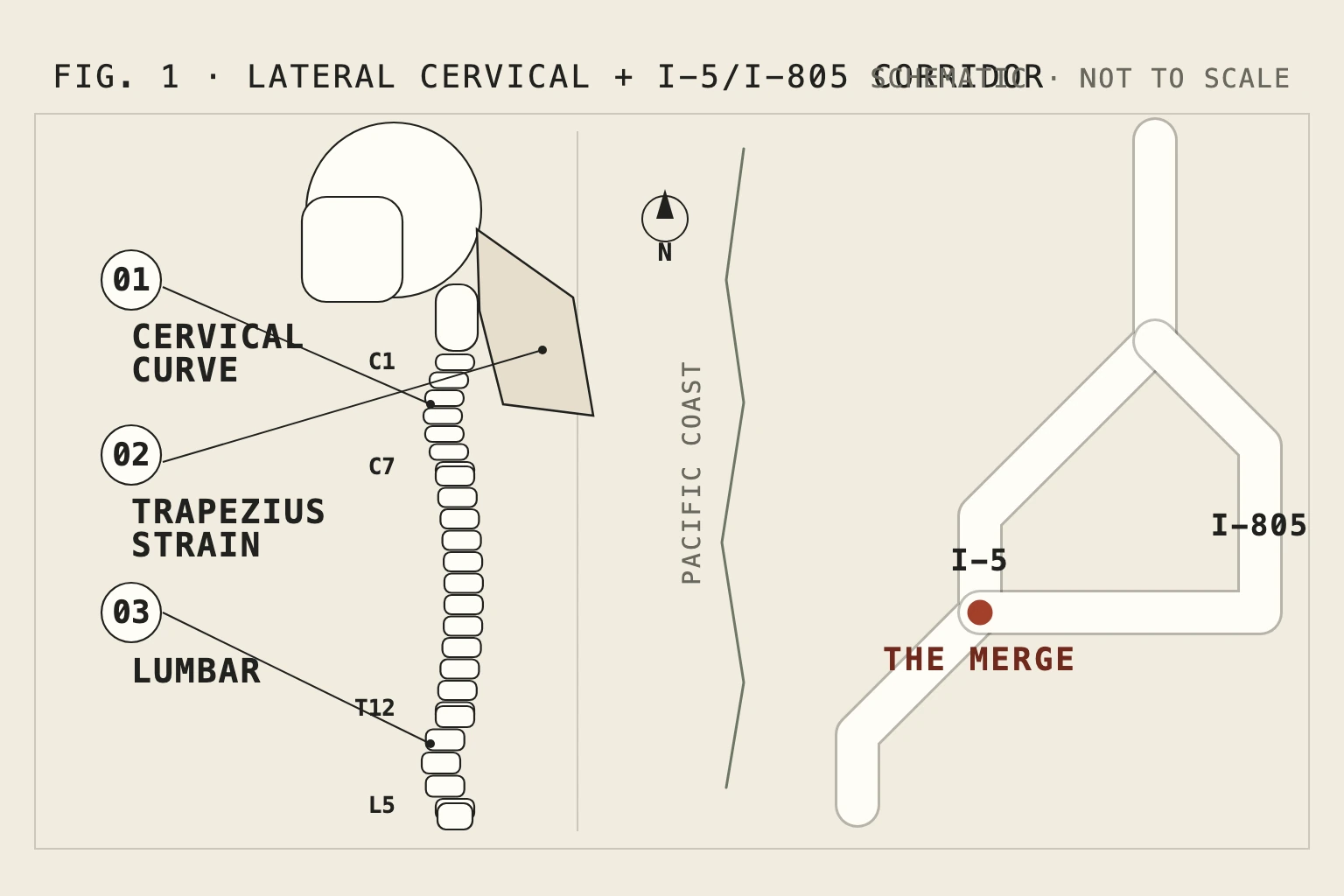
- 01Cervical curvethe neck's forward bend, loaded hardest in a rear-end
- 02Trapezius strainthe neck-to-shoulder muscle that seizes after impact
- 03Lumbarthe low back, braced and jolted at the merge
Four facts that cover most of it
Each carries its source. The topic files expand on all four.
Delayed onset is the pattern, not the exception
Pain and stiffness after a collision commonly peak 24–72 hours later. The tissue response declares itself over days — a defining feature of whiplash-associated disorders.
SRC: Quebec Task Force, Spine 1995 · delayed-onset fileThe record starts before the diagnosis
The first exam, the photos, the symptom log — documentation begins the day of the crash, not the day the pain peaks.
SRC: Cal. Vehicle Code §20008 · documentation fileTwo years is the filing horizon
A personal-injury lawsuit must generally be filed within two years of the injury under Code of Civil Procedure §335.1.
SRC: Cal. Code Civ. Proc. §335.1 · claims fileMinimum limits are statutory, not secret
Post-SB 1107 minimums: $30,000 per person, $60,000 per accident, $15,000 property damage — for policies issued or renewed on or after January 1, 2025.
SRC: Ins. Code §11580.1b · claims fileTopics, in reading order
A ledger, not a blog. Start with the injury pattern, end with where to find care — each file stands alone, each links to the next logical one.
The evidence file, built from day one
Delayed onset means the best evidence is made before the pain peaks. Three files carry the record.
Document your injury
The four-part file: crash record, medical record, loss record, and your own dated notes.
The documentation file → ST-04Imaging and records
What X-ray, CT, and MRI each show — and your right under California law to inspect and copy the results.
The imaging file → ST-05Recovery timelines
Ranges with sources: what the clinical literature reports, and why a range is never a promise.
The timelines file →Three dates that structure the file
Two are statutory. One is clinical sense. All three reward acting early.
The SR-1 report
Where a collision involves injury, death, or property damage above the statutory threshold, California requires a written report to the DMV within 10 days (Vehicle Code §20008).
The documentation file →The first evaluation
Symptoms that declare 24–72 hours after a crash are the rule. The first record starts the documentation chain — and the symptom log bridges the gap until then.
Delayed onset, explained →The filing deadline
Personal-injury lawsuits must generally be filed within two years of the injury (Code of Civil Procedure §335.1). A claim fully documented is a claim; a deadline is a deadline.
The claims file →Editorial standards, stated plainly
A reference publication. What that commits us to — and what it rules out.
Every claim carries a source
Statutory and medical statements map to public primary sources, listed at the foot of each file. No invented statistics, averages, or anecdotes.
No one sponsors a word
No advertising, no referrals, no affiliate links, no paid placement, no provider endorsements. The desk has no client to please.
Errors get fixed on the record
Corrections policy and editorial method are published on the About page, and every fix updates the file's review date.
Asked often, answered briefly
The full FAQ carries twelve answers with sources; these are the three most asked.